The myths
Myth 1False
“But isn’t card counting illegal?”
I, like many other card counters, have heard that question through the years. It is not. In New Jersey it has even been ruled unlawful to back someone off a game for card counting. That means card counting isn’t just legal; in some situations it is protected by law.
Myth 2Partly true
“The casino will just kick you out, and then all of the casinos will know.”
This myth has some truth to it. Casinos will ask you to leave the table if you are caught card counting. But many casinos will ask you to leave simply for being a winner, and contrary to popular belief, in most states that is their right. I have seen it happen numerous times over my years working in casinos.
While casinos do talk, they tend to have a short memory unless you have been kicked out of that specific property before. The neighboring casinos will forget all about you by the end of the week.
Counting cards in your head
No U.S. state makes it a crime to keep track of the cards the dealer shows everyone at the table.
New Jersey
Atlantic City casinos may not bar you for counting cards. Only the state’s Casino Control Commission can set the rules of a licensed game, and it has never ruled counters out.
Uston v. Resorts International Hotel, Supreme Court of New Jersey, 1982
A device that counts for you
Nevada makes it a crime to use, or carry intending to use, any device that keeps track of the cards: a phone app, a hidden computer, anything but your head.
Nevada Revised Statutes 465.075
Counting is a skill, not a device. The line the law draws is between using your memory and using a machine.
What counting actually does
Card counting is a simple, easy-to-learn method that tracks the ratio of high cards to low cards. That ratio tells us when to raise our bets, whether to hit or stand on our 16s, and whether or not to take insurance. It gives us an informed look at how best to play our hands.
The playing thresholds are index numbers from the Illustrious 18 in Don Schlesinger’s Blackjack Attack, as republished by the Wizard of Odds.
The true edge of card counting comes from the fact that when the deck is rich in high-value cards, aces and tens, more blackjacks will be dealt. This is why getting our money in during a high count is so important.
Make no mistake, however: the dealer is just as likely to be dealt that blackjack as anyone else at the table. The true edge comes from the fact that the dealer has to pay us 3:2 every time we have a blackjack, and every time the dealer has a blackjack, they just take our same bet.
Bet small while the count is low, and more as it climbs. This is where most of a counter’s edge comes from.
Stand at a true count of 0 or higher; hit below it. Basic strategy on its own says hit.
Take it at a true count of +3 or higher. Below that, too few tens are left for it to pay.
When you both have one, it is a push. Two-card blackjack odds computed for this page; the +5 shoe assumes its surplus high cards split between tens and aces in their natural four-to-one ratio.
The Hi-Lo values
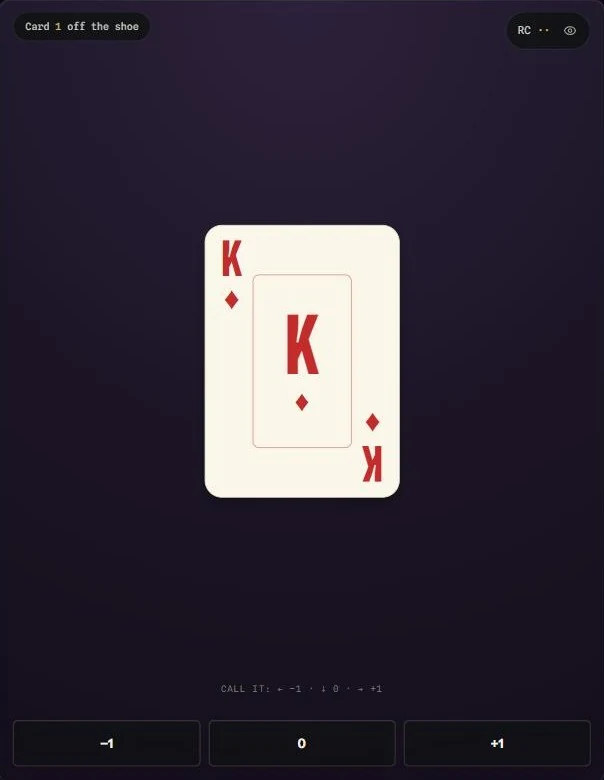
Now that you have a brief understanding of card counting and how it works, we can delve into how to count cards. First, we assign a value to every card:
- +1
- 2, 3, 4, 5 and 6. As we remove them, the share of high cards left in the shoe increases.
- 0
- 7, 8 and 9 are neutral. These cards have essentially no impact on our ability to win, or the dealer’s.
- −1
- 10, jack, queen, king and ace. As they appear, we begin to lose our edge.
Hi-Lo is balanced: a full deck counts back to zero, so a positive count always means more high cards are left than low ones. Count every card you see, including the other players’.
How did we come up with these values? If we look at the effect of card removal, how much the player’s expected value moves when a single card of each rank leaves the shoe, the pattern is plain. We simply measured the effect of removing each card and rounded the results to either +1, 0 or −1.
The method we will utilize, the same method that was made famous by movies such as 21, and the same method used by casino personnel themselves, is Hi-Lo. It is by far the easiest and most fleshed-out system currently known.
There are other card counting methods, such as Omega II, Hi-Opt I and II, Zen, Knock-Out and Wong Halves, among others. We will not be touching much on those. However, if you were wondering why there isn’t a count that rounds to the effects of card removal more accurately, Wong Halves may interest you.
One deck: 20 low × +1 + 12 neutral × 0 + 20 high × −1 = 0
| Card | Stands S17 | Hits S17 | Effect (S17) | Hi-Lo |
|---|---|---|---|---|
| 2 | +0.069% | +0.071% | +1 | |
| 3 | +0.082% | +0.086% | +1 | |
| 4 | +0.110% | +0.117% | +1 | |
| 5 | +0.141% | +0.143% | +1 | |
| 6 | +0.079% | +0.084% | +1 | |
| 7 | +0.041% | +0.038% | 0 | |
| 8 | −0.008% | −0.010% | 0 | |
| 9 | −0.040% | −0.045% | 0 | |
| 10 | −0.091% | −0.097% | −1 | |
| Ace | −0.094% | −0.084% | −1 |
Change in the player’s expected value when one card of the given rank is removed from a six-deck shoe (double on any two cards, double after split, split once). Low cards leaving help you; tens and aces leaving hurt. Hi-Lo rounds each effect to +1, 0 or −1: the 7 and the 9 are close enough to zero to ignore. Source: Wizard of Odds, computed with the Composition Dependent Combinatorial Analyzer at bjstrat.net.
| System | 2 | 3 | 4 | 5 | 6 | 7 | 8 | 9 | 10 | A | Level | Tracks the effect |
|---|---|---|---|---|---|---|---|---|---|---|---|---|
| Effect of removal (ten = −1) | +0.76 | +0.90 | +1.21 | +1.55 | +0.87 | +0.45 | −0.09 | −0.44 | −1.00 | −1.03 | — | 1.00 |
| Hi-Lo This guide | +1 | +1 | +1 | +1 | +1 | 0 | 0 | 0 | −1 | −1 | 1 | 0.96 |
| Knock-Out (KO) Unbalanced | +1 | +1 | +1 | +1 | +1 | +1 | 0 | 0 | −1 | −1 | 1 | 0.96 |
| Hi-Opt I | 0 | +1 | +1 | +1 | +1 | 0 | 0 | 0 | −1 | 0 | 1 | 0.89 |
| Hi-Opt II | +1 | +1 | +2 | +2 | +1 | +1 | 0 | 0 | −2 | 0 | 2 | 0.92 |
| Omega II | +1 | +1 | +2 | +2 | +2 | +1 | 0 | −1 | −2 | 0 | 2 | 0.93 |
| Zen | +1 | +1 | +2 | +2 | +2 | +1 | 0 | 0 | −2 | −1 | 2 | 0.96 |
| Wong Halves | +0.5 | +1 | +1 | +1.5 | +1 | +0.5 | 0 | −0.5 | −1 | −1 | 3 | 0.99 |
“Tracks the effect” is each count’s betting correlation: how closely its values follow the effect of removal in Fig. 5 (six decks, dealer stands on soft 17, tens weighted four to one), computed for this page. Hi-Lo gets 0.96 with nothing but +1, 0 and −1. Wong Halves reaches 0.99 by counting in halves. KO is unbalanced (a full deck sums to +4), which is how it skips the true count conversion.
The running count
At the beginning of every shoe, our count will begin at 0, and we will count the cards as we see them.
This gives us a running count of +1. We are trending in the right direction; however, this is not enough for us to make a decision, as the majority of the time we are going to be playing a multi-deck shoe of anywhere from 2 to 8 decks. We have to convert this number into something that better reflects the impact of our count after the dilution created by having multiple decks. This is where we begin converting our running count to the “true count.”
Cards count in the order they are dealt: your first card, the dealer’s up card, your second card. The hole card counts once it is turned over.
The true count
The true count is calculated by simply taking your running count and dividing it by the number of decks remaining. For example, if we have a running count of +4 with 2 decks remaining out of a six-deck shoe, we divide the +4 by the 2 remaining decks to get a true count of +2.
The true count means everything to a professional card counter. Understanding the impact of the true count is fundamentally second only to having complete mastery over card counting itself.
- Stand on 16 against a 10 TC 0 or higherOn
- Start your bet ramp TC +2.5 or higherOff
- Take insurance TC +3 or higherOff
A six-deck shoe. The same +4 means twice as much with two decks left as it does with four, because the extra high cards are packed into half as many cards. Change the numbers and watch which signals switch on.
How to play based on your count
Now that you know how to calculate your true count, we need to know what it tells you. In a typical game of blackjack, whether it be 2 or 8 decks, you will cross the threshold from losing situations to winning situations around a true count of +2.5. This is when you begin your “bet ramp,” the method by which you increase your bets.
There are many different methods that card counters will use to try to hide or disguise their bet ramps, from only pressing on winning hands to playing multiple hands so that their larger bet appears as three smaller bets. In my experience working in the casino, the multiple-hand method is by far the most overrated and least effective.
I find it’s best to leave your betting to be an art, instead of a mechanical, methodical press that can be easily identified.
An example, not a prescription: your unit and your top bet depend on your bankroll and on how much attention the table can take. Below the threshold you bet the minimum; above it your bet climbs with the count.
The pit reads the money on the table, not the number of circles it sits in. Splitting a big bet across hands changes how it looks, not how much it is.
A mechanical press
Every bet is a function of the count and nothing else. The steps are sharp enough to trace.
Betting as an art
Raises come after wins, cuts after losses, and now and then a bet the count didn’t ask for. No single line fits.
Illustration: each dot is one bet, placed at the true count it was made at. The gray line is the ramp from Fig. 9.